Welcome to the Old World campaign setting.
Contents
Introduction
The land of Donaille wallows in medieval stagnation. The king and his court busy themselves with decadence and petty politicking, caring little for what goes on beyond the walls of the capital. The nobles who rule the provinces of the hinterlands spend their time warring against the savage tribes that press upon their borders, while often being little better than barbarians themselves.
The clergy of the Church of Pelor, god of the sun and master of all creation, seem to concern themselves mostly with preserving the status quo. Arcane magic exists, but the average peasant has never seen so much as a cantrip being cast; true adepts of the arcane are few indeed, and are found either serving some wealthy and powerful master or else ensconced in some remote and forbidding tower, avoiding all contact with the world.
The majority of Donaille’s people are peasant farmers who go a lifetime without leaving their home village; there, they spend their lives scratching at the earth, which gives up its fruits with ever greater reluctance.
Such a life was not for you, and you left your home to seek your fortune in Stavronne—capital of the Illustrious Kingdom, greatest (and, to speak frankly, the only) metropolis in all Donaille, and center of the civilized world. You had great plans (vague though they were). Your disappointment was equally great.
Within a week of living in Stavronne, you realized that this was not a city for a man or woman of energy, of drive. The people of the capital, you saw, are concerned immeasurably more with appearances than with actions; they care for manners, breeding, minutiae of status; their ambitions amount to little more than jockeying for position in elaborate hierarchies whose nature you could hardly grasp—nor did you wish to. It would take you years to insinuate yourself into these petty games of power—and to what end?
There was only one place left to go, and that was—west.
To the west of Donaille stretches a great unbroken wilderness—a vast, arid wasteland. It has no single name; some call it the Empty Lands, others dub it the Dry Sea, still others merely refer to “the western wastes”. Where lie that wasteland’s furthest reaches—no one knows. What is beyond it—no one can say. It’s a scorching desert in parts, dry steppe elsewhere.
At the wasteland’s nearest edge is a frontier land, of sorts. People come here not because there’s a reason to come, but because they want to get away from everywhere else: from the stifling, oppressive hierarchy of the capital; from the grinding poverty and feudal servitude of the hinterlands; from the endless internecine war and violence of the savage lands to Donaille’s east and south. Of natural resources, here, there is just enough to survive, but not enough to thrive—which means, not enough to bother annexing, or conquering, or raiding.
But you have heard stories that out in the wasteland there are buried ruins, sand-swept remnants of mighty kingdoms that fell in ages past; and in these ruins, glittering treasures and ancient secrets wait to be discovered…
Setting background
Non-human races in the Old World
Humans are the dominant race in the land of Donaille. Many of the Illustrious Kingdom’s denizens have never met a non-human; one hears stories of elves and dwarves and gnomes, but then again one hears stories of dragons, too—and who has ever seen a dragon? If such beings exist, they are to be found in lands far away; but more likely, they are wholly mythical. Monstrous creatures of vaguely humanoid form do prowl the wilderness, beyond Donaille’s borders—gnolls, for example, or kobolds. But these are hardly to be thought of as people. (Certainly they act more like wild beasts than any semblance of a civilized man.)
There are, however, some non-human inhabitants of the Old World to whom few would deny the badge of personhood.
Orcs and half-orcs
To the east and south of Donaille are lands which support only sparse habitation—various forms of desert, mostly. Dwelling in these harsh places are many tribes of people of the sort the “civilized folks” call barbarians. They are nomads, by and large (though small settlements exist, often huddled around oases or similar fonts of life). Some of these peoples are human (though they look different enough from Donellian stock that the one would never be mistaken for the other)—but not all.
In some ways, the orcs are not much different from the humans of the desert lands: they live in tribes (which are loose groupings of extended-family clans); they lead a nomad lifestyle; they support themselves largely by raiding settled peoples. But in their drive toward violence and chaos, in their seemingly innate inability to exist in groupings larger than a few hundred without turning on each other, and—paradoxical though it may seem—in their unswerving loyalty to their terrible god, the orcs retain enough of the alien to mark themselves as separate, even without the evidence of their appearance.
Still, need and advantage overcome greater obstacles than this; and in the times between raids, there is enough trade and peaceful contact between orc tribes and both the human peoples of the desert lands and, even, the settlements of Donaille’s outer provinces, that children of mixed ancestry are not unknown in those parts. In many villages and towns of the eastern and southern reaches, a half-orc raises no eyebrows if he walks down the street or orders a drink at the local tavern. In the heartland of the Illustrious Kingdom it is different; there, orcish features may provoke gasps of shock, or even violence. In the capital, especially, where beauty and refinement are prized, a half-orc will not find a friendly welcome.
Hobgoblins
The hobgoblins of the south claim that their kind ruled great empires in ages past. The histories of Donaille say nothing of this; yet anyone who has met these people in battle finds it hard to deny that such claims seem, at the least, plausible.
Though they’re tough and hardy, and unquestionably “monstrous” and imposing in appearance, the great advantage hobgoblins boast is their almost supernatural ability to fight in concert. To a degree greater by far than humans (much less orcs), hobgoblins are able to subordinate their individual will to a collective mentality, so effectively that they seem to operate in combat as something more like a singular entity than a mere grouping of warriors. But hobgoblins don’t just make effective soldiers; capable tacticians and leaders are found among them at a frequency greater than any other humanoid race can boast.
Such a talent for the military arts should make hobgoblins masters of the world, by rights (and many of them often say so). Unfortunately, the hobgoblin race is cursed with a fertility much lower than that of humans or orcs (without a greater lifespan to compensate). Whether this is truly some curse from the gods, or a natural phenomenon, none can say; but the fact is that the hobgoblin race has been slowly dwindling for many generations—and now (if the trend is not radically reversed, and soon) approaches its end.
In the meantime, some hobgoblins try to carve out a place for themselves through war and conquest. As there are no longer enough of their own people to form real armies, hobgoblin warleaders gather hordes of lesser creatures—savage humanoids such as goblins or kobolds—and lead them on raids against settled folk. Such incursions are fearsome, to be sure, but they’ve never amounted to a real threat. Other hobgoblins seek employment as mercenaries in Donaille, and in such capacities they often end up fighting their own kind, along with orcs or human tribesmen.
Much like orcs, hobgoblins are just common enough a sight in the towns of Donaille’s southern provinces that their presence is usually accepted, if grudgingly. Further north, their kind is a rare enough sight that most common folk are likely to flee from a hobgoblin’s presence, while a noble’s guardsmen may reach for their swords at the sight of one. And in the capital, where perfumed courtiers, scribes, and guild artisans disdain overt violence as a mark of the lowest breeding, the average hobgoblin is quite unlikely to “fit in”.
(Note: a hobgoblin player character may be a full-blooded hobgoblin, or may have mixed hobgoblin/human ancestry, as per the player’s discretion; this does not affect the character’s game statistics.)
Tieflings
Tieflings are the product of fiendish blood mixed with mortal stock. Or so the stories go, anyhow. Certainly their appearance, varied as it might be (there is no such thing as the “typical” tiefling), quite reliably evokes the demonic or the diabolical—horns, a tail, reptilian scales, slit pupils, a forked tongue, or other features associated with those beings whom the myths identify as hailing from spiritual realms of evil, are all commonplace among the tiefling race (if such they are; there’s little consensus among scholars whether to view tieflings as a people separate from any other, or merely as aberrations within, e.g., a human bloodline).
Attitudes toward tieflings in the land of Donaille are, strangely enough, a mirror image of the way that half-orcs or hobgoblins are treated. In Stavronne, the capital of the Illustrious Kingdom, tieflings are seen as excitingly exotic; their strange appearance tends to lend them an air of mystery, and their supposed fiendish heritage evokes the forbidden, the sinful, the transgressive. Having a tiefling among one’s associates is, for many young aristocrats, a way to signal one’s rebellious nature without actually committing any acts that would risk one’s legal status (or one’s immortal soul). (Translating this fashionability into personal benefit is another matter, of course; many’s the tiefling who has found this to be the greater challenge than merely gaining acceptance into the capital’s social circles.)
On the other hand, the ignorant peasants and barely civilized feudal lords of Donaille’s hinterlands will look at a tiefling and see a fiend, a monster to be driven out or slain. Tieflings traveling in the outer provinces are well advised to hide their nature—or else to be very good in a fight.
Magic in the Old World
The following are the major ways in which magic in the Old World differs from that in most other settings.
Long-range teleportation magic (teleport, etc.) is believed to be theoretically possible, but the secret of its use has been lost.
Magic that allows travel to other planes (plane shift, gate, etc.) doesn’t work, and, so far as anyone knows, never has. (According to legend, anyone who has ever attempted to use magic that purports to enable planar travel has, to all appearances, simply died or vanished, with no evidence that they actually went anywhere in any literal sense.) The concept of traveling to other planes of existence is generally considered by scholars to be either confused or mythical. So far as is generally known, nobody has ever traveled to another plane, nor even proven conclusively that other planes actually exist.
(Transitive planes such as the Astral, the Ethereal, and Shadow are somewhat of an exception; magic that allows travel to, or perception of, such planes is known, although very rare. Such domains are considered to have an existence of a spiritual rather than physical nature. Similarly, magic that summons or calls extraplanar beings does exist—but, again, the idea that the home planes of such entities are real places which it is possible for a mortal to actually visit is rejected by most scholars. It is said that outsiders are exceedingly reluctant to speak of their home realms, which is generally viewed as confirmation that said realms are not “real” in the way that the mortal world is.)
Resurrection magic exists, but its use is frowned upon. The church of Pelor teaches that bringing back the dead takes life from the world; and that resurrection is permissible only in those cases when the Great God Above decrees that the return to life would give back to the world more than it takes. (The Faithful of the Sun are not the only ones who can return life to the dead, of course; but other avenues of returning from beyond the veil of death are said to bear various terrible prices.) Those few who have been resurrected remember little of what (if anything) they experienced between dying and being revived.
Spells which conjure physical matter (create water, wall of iron, etc.) do not create material ex nihilo, but draw it from the surrounding environment. Where the material to be created is scarce, casting the spell is difficult. (More powerful spellcasters have an easier time of it because they can “reach further” outward from their location to draw forth the matter to be conjured.) For example, create water is, ironically, quite difficult to cast in the desert (and gets harder to cast in any given location each time the casting succeeds, as what little available water there is in the arid environment is quickly exhausted). It is generally accepted that conjuration magic can only draw material from natural structures, not from creatures or artificial works (although stories exist which suggest otherwise).
General knowledge of magic is at a very low level in the Old World. Most commoners have never seen a single spell being cast, nor met a spellcaster. Perhaps a handful of true scholars of the arcane exist in all of Donaille—and these hoard their knowledge jealously. Even most educated people have only a vague idea of how magic works, or what it can do, or anything else about it. Wielders of magic (of any kind)—with the exception of priests of Pelor—are treated with either suspicion and fear, or with fascination, envy, and greed (the latter being the more common attitude in the capital, while the former is the default in the hinterlands).
Magic items in the Old World
Creating an enchanted sword, or some other such magic weapon or item, must be possible, surely—such things exist, so someone must have made them, once. Yet you’ve never heard of anyone actually doing such a thing. Perhaps the few great wizards and sorcerers who live in their remote towers know the secrets of magical item crafting; or perhaps the king’s court wizards labor to create enchanted items for His Exuberant Majesty. If these things are true, however, they are certainly not generally known.
Such magic items that exist tend to be highly valued as family relics, and never sold. Folks of the lower classes, who dare not even dream of ever owning so much as a spoon +1, whisper stories that all enchanted items bear curses that ensnare their owner and inflict some horrible fate upon him, with the worst such curses attaching to the mightiest of magic weapons or enchanted armor. (Such tales might be attributed merely to “sour grapes”, however.)
Wizards know the means of inscribing spells onto magic scrolls, and such scrolls may even be found for purchase, if one knows the right sorts of people. Alchemists (who may be found in any decently-sized town) can brew potions which mimic the effects of certain spells, and these too may be purchased.
Gods & religion in the Old World
Worship of Pelor, god of the sun, is ubiquitous in Donaille. The Shining Lord’s clergy are the dominant religious power in the Illustrious Kingdom; indeed, their influence extends as far as boundaries of those lands which owe fealty to His Prodigious Majesty (although the nobles who rule the outermost provinces often leave something to be desired when it comes to material demonstrations of their faith, and indeed some of them pay homage to other, lesser gods, as well).
The Radiant One, in his unfathomable vastness and multiplicity, is worshipped in many ways. The faithful may offer prayer and supplication to the Great God Above directly, of course, but many find it more congenial to address intermediaries, instead; thus the church acknowledges a multitude of saints, angels, celestial servants, and a variety of other entities which are perhaps not quite gods, yet represent some particular aspect of Pelor’s power and influence. A knight might pray to Raziel before going into battle with barbarians, while a trapper might make an offering to Cernunnos before going into the woods for furs. All such acts of worship ultimately glorify the Shining Lord—thus teaches Pelor’s church.
The human barbarians who dwell in the lands to Donaille’s east and south usually follow Pelor as well, although the form of their worship differs greatly from that which is common among the “civilized people”. Some tribes also cling to a sort of ancestor worship, though they do not see any conflict between such practices and the solar faith.
Orcs worship Gruumsh, their terrible god of rage and conquest. They also pay homage to the One-Eyed God’s favored servants—mythical warriors of ages past, now revered as demigods—and other divine and semi-divine beings who serve Gruumsh.
Hobgoblins generally distrust gods, and have no shared faith as a people. Those hobgoblins who find faith generally follow whatever god whose worship best suits their ambitions in life. (For hobgoblins living among the humans of Donaille, this is most likely to be Pelor—piousness is a good way to gain acceptance in Donellian society).
One sometimes hears rumors that cults of evil gods, or fiends, or other dark powers, lurk in the dark corners of the land, and that the secret members of such cults conduct horrible rituals in their patrons’ service—acts of depravity, sacrifice, and worse. Most such rumors are surely fabrications, or the imaginings of the ignorant and foolish.
Timekeeping in the Old World
The Pelorite calendar is used in Donaille.
The following pages list some additional information about the Old World campaign setting.
Allowed materials
The Old World campaign setting can be used with a number of different systems. Accordingly, the allowed materials list for player characters in the setting, and the applicable house rules, depend on the system being used for any given adventure.
Note: See also the section on magic in the Old World.
All systems
Races
See the Races page for information on available player character races, and their racial traits and qualities.
The setting background section describes what place each of the player character races has in the setting.
Pathfinder
Skills
The Knowledge (the planes) skill is not available. (See magic in the Old World for more information.)
When using the Intimidate skill to demoralize opponents, any bonuses to saves against fear (such as those granted by the bard’s inspire courage ability, or by the bless spell) apply to the Intimidate check DC.
The Handle Animal skill works differently in the Old World campaign setting; see the linked page for details.
Feats
See the Feats page for information on feats that are available in the Old World campaign setting.
Classes
The following classes are available:
- Core Rulebook
- base classes:
- barbarian
- bard
- The bard class is modified; see the Bard page for details.
- cleric
- druid
- fighter
- monk
- The monk class is heavily modified; see the Monk page for details.
- paladin
- ranger
- rogue
- sorcerer
- wizard
- prestige classes:
- arcane trickster
- assassin
- duelist
- eldritch knight
- Advanced Player’s Guide
- base classes:
- oracle
- witch
- The witch class is heavily modified; see the Witch page for details.
- summoner
- The summoner class is modified; see the Summoner page for details.
- prestige classes:
- holy vindicator
- rage prophet
- Ultimate Magic
Some of the available classes are modified from their published versions. See below for changes to specific classes.
Barbarian
Rage
In the description of the barbarian’s rage class ability, replace this sentence:
If a barbarian falls unconscious, her rage immediately ends, placing her in peril of death.
With this:
If a barbarian falls unconscious while raging, then at the end of his next turn (or his current turn, if he falls unconscious on his own turn), his rage ends. While the ending of the rage causes the barbarian’s hit points to drop (due to the loss of the Constitution bonus granted by rage), this cannot reduce his hit point total below a value 1 point higher than his death threshold.
(Of course, the barbarian may continue losing hit points thereafter, in all the usual ways. Most commonly, if the unconsciousness was caused by damage which brought the barbarian’s hit points below 0, then—unless his condition stabilizes before then, or he regains hit points in some way—he will lose 1 hit point at the end of his subsequent turn, one round after his rage has ended; this, naturally, will kill him.)
Rage powers
See the Rage Powers page for a list of rage powers available in the Old World campaign setting.
Bard
The bard class is modified; see the Bard page for details.
Cleric
Cleric domains
The following domains and subdomains are available for clerics of the deities worshipped in the Old World campaign setting. (Subdomains are listed in parentheses after the base domain. Unless noted otherwise, either the base domain or any of the listed subdomains may be selected by clerics who follow the given deity.)
- Pelor (a.k.a. the Shining Lord, the Radiant One, the Great God Above, etc.)
- Note: Many of the domains and subdomains listed here are provided by various divine intermediaries (saints, celestial lords, etc.). See the section on gods & religion in the Old World for details.
- Air (Cloud, Wind)
- Animal (Feather, Fur)
- Charm (Love)
- Community (Family, Home)
- Earth (Metal)
- Fire
- Glory (Heroism, Honor)
- Good (Archon, Eladrin, Guardinal)
- Healing (Restoration)
- Law
- Luck (Fate)
- Nobility (Leadership, Martyr)
- Plant (Growth)
- Protection (Defense, Purity)
- Repose (Ancestors, Souls)
- Strength (Resolve)
- Sun (Day, Light)
- War (Tactics)
- Weather (Seasons, Storms)
- Gruumsh (a.k.a. the One-Eyed God)
- Various evil gods, demon princes, archdevils, etc.
- ??? (probably also someone evil? this sounds pretty evil to me. stay away from this stuff imo)
Fighter
Advanced training
At 9th, 13th, and 17th levels, when the fighter would select an additional weapon group for his weapon training feature, he can instead choose to gain one of the following abilities. (The fighter’s weapon training bonus still increases for weapons from all weapon groups he previously selected with weapon training.)
Fighter’s Tactics: All of the fighter’s allies are treated as if they had the same teamwork feats as the fighter for the purpose of determining whether the fighter receives a bonus from his teamwork feats. His allies do not receive any bonuses from these feats unless they actually have the feats themselves. The allies’ positioning and actions must still meet the prerequisites listed in the teamwork feat for the fighter to receive the listed bonus.
Additionally, the fighter gains one teamwork feat for which he qualifies.
Flexible Combat Feat: The fighter gains one combat feat for which he qualifies. Unlike his other feats, this feat is not fixed, and may be replaced with any other combat feat the fighter qualifies for, with an hour of practice and martial exercises. This may be done once per day. (In effect, the fighter unlearns the selected feat, and learns a new one in its place.)
While a flexible combat feat may be used to satisfy the prerequisites of other feats, as any other feat can, note that if the fighter chooses to replace the flexible combat feat, and if this causes him to no longer satisfy the prerequisites of another feat, then the fighter loses the use of the feat(s) for which he no longer qualifies. (Those other feats are not lost; the fighter still has them, but may not use them or gain their benefits, unless he once again satisfies their prerequisites.)
This ability may be selected multiple times, gaining an additional flexible combat feat each time. The fighter may choose to replace all, some, or none of his flexible combat feats each day. He may even use one chosen flexible combat feat to qualify for another such feat (e.g., to gain Power Attack and Furious Focus).
Shrug Off: The fighter may choose to use his Fortitude save bonus when making a Reflex or Will saving throw. This ability may be used once per day at 9th fighter level, twice per day at 13th fighter level, and three times per day at 17th fighter level.
Mettle: If the fighter makes a successful Will or Fortitude save against an attack that normally would have a lesser effect on a successful save (such as any spell with a saving throw entry of Will half or Fortitude partial), he instead completely negates the effect. An unconscious or sleeping fighter does not gain the benefit of mettle.
Leader of Men: The fighter must have a Charisma score of 13 or greater to select this ability. He gains Diplomacy as a class skill, and Great Leader as a bonus feat. His very presence inspires others; any allies who can see the fighter gain a +3 morale bonus to attack rolls and saves against fear. This bonus is lost if the fighter is disguised, unconscious, or otherwise incapacitated.
Fighter archetypes that remove the fighter’s weapon training class feature may not gain advanced training abilities.
Magus
Spell list
The magus’s spell list (not including those spells which may be researched or discovered) is given on the Spell Lists page.
Monk
The monk class is modified; see the Monk page for details.
Ki powers
See the Ki Powers page for a list of ki powers available in the Old World campaign setting.
Ranger
Favored enemy
The ranger’s favored enemy ability is modified as follows:
Favored Enemy (Ex): If a ranger spends at least a day observing, tracking, or otherwise interacting with creatures of some sort, he may designate such creatures as a favored enemy.
The ranger gains +2 bonus on Bluff, Knowledge, Perception, Sense Motive, and Survival checks against his favored enemies. Likewise, he gets a +2 bonus on weapon attack and damage rolls against them. A ranger may make Knowledge skill checks untrained when attempting to identify these creatures.
A ranger may have one favored enemy at a time (that is, he may only designate one kind of creature as a favored enemy; if he wishes to designate another kind of creature as a favored enemy, he loses his favored enemy bonuses against any other kinds of creatures).
At every fifth level (5th, 10th, etc.), the ranger may have one additional favored enemy at a time. The ranger’s bonuses against favored enemies also increase by +2 at these levels.
Combat styles
The list of bonus feats available for each ranger combat style is modified.
Archery combat style:
- 2nd level:
- 6th level:
- 10th level:
Two-weapon combat style:
- 2nd level:
- 6th level:
- 10th level:
Crossbow combat style:
- 2nd level:
- 6th level:
- 10th level:
Mounted combat style:
- 2nd level:
- 6th level:
- 10th level:
Natural weapon combat style:
- 2nd level:
- 6th level:
- 10th level:
Two-handed weapon combat style:
- 2nd level:
- 6th level:
- 10th level:
Weapon and shield combat style:
- 2nd level:
- 6th level:
- 10th level:
Urban ranger
The urban ranger archetype’s favored community ability is replaced by the following:
Favored Terrain (Ex): At 3rd level, an urban ranger gains favored terrain (urban). This functions as the normal favored terrain ranger class feature, except as noted below. The urban ranger cannot select a different favored terrain.
The urban ranger’s favored terrain bonus applies to Knowledge (local) (for any community where he is located) instead of Knowledge (geography). At 8th level, and every fifth level thereafter, the ranger’s favored terrain bonuses increase as normal, but he does not gain a new favored terrain.
Additionally, at 3rd level, the urban ranger gains the Urban Tracking skill trick, without having to spend skill points or meet the prerequisites. At the ranger’s option, he can use the Knowledge (local) skill in place of the Diplomacy skill for the purpose of urban tracking.
Rogue
Rogue talents
See the Rogue Talents page for a list of rogue talents available in the Old World campaign setting.
Summoner
The summoner class is modified; see the Summoner page for details.
Witch
The witch class is modified; see the Witch page for details.
Prestige classes
Duelist
The feat prerequisites of the duelist class are modified as follows: Dodge, Weapon Finesse. (The other prerequisites are unchanged.)
Holy vindicator
The feat prerequisite of the holy vindicator class is modified as follows: Improved Channel. (The other prerequisites are unchanged.)
Rage prophet
The savage seer class ability is modified as follows:
Savage Seer: A rage prophet’s class level stacks with barbarian levels for determining the effect of rage powers, as well as for determining which rage powers he may select (should he gain additional rage powers, e.g. by taking more levels in the barbarian class, or gaining the Extra Rage Power feat), and stacks with oracle levels for determining the effect of oracle revelations and his oracle’s curse, as well as for determining which revelations he may select (should he gain additional revelations). This does not grant additional abilities.
The raging healer class ability is modified as follows:
Raging Healer (Su): At 2nd level, a rage prophet is able to cast cure spells on himself while raging, without having to use the moment of clarity rage power.
The ragecaster class ability is modified as follows:
Ragecaster (Su): Starting at 4th level, a rage prophet’s spells grow more potent when he rages. When casting spells while raging (e.g., by using the moment of clarity rage power, or via the raging healer or raging spellstrength class abilities), he adds his barbarian level to his caster level. At 7th level, he adds his Constitution bonus to the save DC of any spells cast while raging.
The raging spellstrength class ability is modified as follows:
Raging Spellstrength (Su): At 8th level, a rage prophet is able to cast spells with a range of “personal” on himself while raging, without having to use the moment of clarity rage power.
Spells
Spell lists
The Spell Lists page lists all the spells available for all the classes available to player characters in the Old World setting.
Spells & higher level spell slots
Using a higher-level spell slot to cast a spell increases the spell’s effective level for the purposes of calculating saving throw DCs, interaction with a globe of invulnerability, etc. (In other words, all spellcasters get the equivalent of the Heighten Spell feat for free, as a basic feature of the spellcasting system.)
(See also Metamagic feats.)
New & modified spells
The following new spells are available in the Old World setting:
The following spells are not commonly available in the Old World setting (they cannot be learned without finding a scroll, spellbook, etc. containing that spell):
- clone
- gate
- getaway
- planar adaptation
- planar adaptation, mass
- plane shift
- simulacrum
- refuge
- teleport
- teleport, greater
- teleportation circle
- teleport object
- transport via plants
- word of recall
The following spells work differently in the Old World setting:
The following spells have their material components modified:
| Spell | New material component |
|---|
| animate dead | black onyx gems worth at least 25 gp per Hit Die of the undead, placed into the mouth and/or eye sockets of each corpse to be animated (the magic of the spell turns these gems into worthless, burned-out shells) |
| circle of death | a black pearl worth at least 500 gp |
| continual flame | a powder made from semi-precious gemstones with a total value of at least 50 gp |
| create undead | black onyx gems worth at least 50 gp per Hit Die of the undead, placed into the mouth and/or eye sockets of each corpse to be animated (the magic of the spell turns these gems into worthless, burned-out shells), plus a clay pot filled with grave dirt and another filled with brackish water |
| forcecage | a powder made from precious gemstones with a total value of at least 500 gp, which is tossed into the air and disappears when you cast the spell |
| glyph of warding | you trace the glyph with incense, which must first be sprinkled with powder made from precious gemstones with a total value of at least 200 gp |
| greater glyph of warding | you trace the glyph with incense, which must first be sprinkled with powder made from precious gemstones with a total value of at least 400 gp |
| nondetection | a gemstone worth at least 50 gp |
| protection from spells | a precious gemstone worth at least 500 gp |
| stoneskin | powdered granite (which is sprinkled on the target’s skin), plus a precious gemstone worth at least 250 gp |
| symbol of death | mercury and phosphorus, plus diamonds and opals with a total value of at least 5,000 gp |
| symbol of fear | mercury and phosphorus, plus diamonds and opals with a total value of at least 1,000 gp |
| symbol of insanity | mercury and phosphorus, plus diamonds and opals with a total value of at least 5,000 gp |
| symbol of pain | mercury and phosphorus, plus diamonds and opals with a total value of at least 1,000 gp |
| symbol of persuasion | mercury and phosphorus, plus diamonds and opals with a total value of at least 5,000 gp |
| symbol of sleep | mercury and phosphorus, plus diamonds and opals with a total value of at least 1,000 gp |
| symbol of stunning | mercury and phosphorus, plus diamonds and opals with a total value of at least 5,000 gp |
| symbol of weakness | mercury and phosphorus, plus diamonds and opals with a total value of at least 5,000 gp |
| temporal stasis | a powder made from precious gemstones with a total value of at least 5,000 gp |
| undeath to death | a precious gemstone worth at least 500 gp |
The following spells have their focuses modified:
| Spell | New focus |
|---|
| protection from spells | a precious gemstone worth at least 1,000 gp for every protected creature |
Weapons
Replace the descriptions of longbows (including composite and mighty composite longbows, which no longer exist) and shortbows (including mighty composite shortbows, which no longer exist) in the Core Rulebook with the descriptions on the Equipment page.
Weapon groups
Each weapon belongs to a group of similar weapons, such as axes (which includes one-handed, two-handed, and throwing axes) or polearms (which includes halberds and glaives). A weapon can belong to more than one group (for example, daggers are included in basic weapons as well as in light blades).
All characters are proficient with basic weapons. Most characters also gain proficiency with one or more additional groups of weapons, depending on their class (see each class’s description for details). A character can gain proficiency with additional weapon groups by taking the Weapon Proficiency feat. A character who uses a weapon with which he or she is not proficient takes a −4 penalty on attack rolls.
Note: Characters and classes do not lose any weapon proficiencies with this rule. All characters gain proficiency with basic weapons, in addition to whatever weapon proficiencies they may already have in the standard rules.
Common weapon groups include the following:
- Axes
- Basic weapons (club, dagger, sling, sap, quarterstaff)
- Bows (longbows and shortbows)
- Cavalry weapons (curved swords, lance, shortbow)
- Crossbows
- Hammers (warhammer, great maul)
- Heavy blades (longsword, bastard sword, greatsword, etc.)
- Light blades (dagger, short sword, rapier)
- Maces & clubs (including the morningstar)
- Polearms (halberd, glaive, etc.)
- Shields
- Note: Characters who are proficient with shields are also automatically proficient with the use of shields as weapons (i.e. using them to make a shield bash)
- Spears (shortspear, longspear, javelin)
- Unarmed attacks (unarmed strikes, as well as gauntlets, brass knuckles, etc.)
Exotic weapons
There are some weapons that do not resemble the common weapon types described above. These are usually weapons designed for specific purposes, or for use with unusual fighting techniques. A character who is not proficient with an exotic weapon must take the Weapon Proficiency feat for that specific weapon in order to use it properly (that is, exotic weapons are generally not considered to be part of any common weapon group). (In cases where an exotic weapon is fairly similar to a non-exotic weapon with which a character is proficient, the character is also considered to be proficient with that exotic weapon, but is unable to use the special or distinguishing features of the exotic weapon unless he takes the Weapon Proficiency feat for that specific exotic weapon.)
Combat maneuvers
Attempting a combat maneuver (such as disarm, trip, etc.) no longer provokes an attack of opportunity. However, failing a combat maneuver check does provoke an attack of opportunity from the defender.
Details, and specific rules and exceptions that apply to specific combat maneuvers, are as follows.
| Combat Maneuvers |
|---|
| Maneuver | Effect | Action | Can use
weapon? | −4 if
unarmed? | Target size
category |
|---|
| Bull rush | Target pushed | standard or charge | no | no | up to 1 larger |
| Dirty trick | Target takes temporary penalty | standard | no | no | any |
| Disarm | Target drops weapon | melee attack | yes | yes | any |
| Drag | Target pulled | standard | no | yes | up to 1 larger |
| Grapple | You are grappling target | standard | no | yes | any |
| Overrun | Target knocked prone | standard or charge | no | no | up to 1 larger |
| Reposition | Target moved | standard | no | no | up to 1 larger |
| Steal | You take item from target | standard | whip | no | any |
| Sunder | Target’s gear damaged or destroyed | melee attack | yes | yes | any |
| Trip | Target knocked prone | melee attack | trip weapons | no | up to 1 larger |
Failing a Combat Maneuver Check: If you fail your combat maneuver check, you provoke an attack of opportunity from the defender. (Any attack the defender makes against you as part of that attack of opportunity cannot provoke an attack of opportunity from you in turn, even if that sort of attack or maneuver would normally provoke an attack of opportunity. Thus it’s impossible to have, e.g., a back-and-forth chain of trip attacks, each triggered by the previous failed attempt of the other combatant.)
Attempting Combat Maneuvers While Unarmed: In the case of certain combat maneuvers (disarm, drag, grapple, and sunder), if you are attempting the maneuver against an armed opponent while you are unarmed yourself, you take a −4 penalty on your combat maneuver check. Having the Improved Unarmed Strike feat, using a natural weapon, or using a manufactured weapon (including a spiked gauntlet, but not a regular gauntlet) allows you to avoid this penalty. This penalty never applies when attempting such combat maneuvers against an unarmed opponent.
Bull rush
Action: You can attempt to bull rush your opponent as a standard action or as part of a charge (in place of the melee attack at the end of the charge).
Failure: If your check fails, your opponent is not moved, your movement ends in front of the target, and you provoke an attack of opportunity from him.
Feat: The Improved Bull Rush feat grants you a bonus to bull rush combat maneuver checks, and (if your BAB is at least +6) causes your opponent’s movement to provoke AoOs from your allies.
Dirty trick
Action: You can attempt to hinder your opponent with a dirty trick as a standard action.
Failure: If your check fails, your opponent takes no penalty, and you provoke an attack of opportunity from him.
Feat: The Improved Dirty Trick feat grants you a bonus to dirty trick combat maneuver checks, and (if your BAB is at least +6) makes the penalty imposed by a dirty trick last longer and be harder to remove.
Disarm
Action: You can attempt to disarm your opponent in place of a melee attack.
You can make a disarm attempt with a weapon or with an unarmed strike.
Unarmed Penalty: If you are attempting a disarm while unarmed yourself, you take a −4 penalty on your combat maneuver check unless you have the Improved Unarmed Strike feat (or a similar ability that causes you to threaten your opponent with your unarmed attacks). (You likewise do not take this penalty if you are using a natural weapon to perform the disarm.)
Failure: If your check fails, your opponent is not disarmed, and you provoke an attack of opportunity from him.
Feat: The Improved Disarm feat grants you a bonus to disarm combat maneuver checks, and (if your BAB is at least +6) allows you to hurl the disarmed weapon 15 feet away.
Drag
Action: You can attempt to drag your opponent as a standard action.
Unarmed Penalty: You take a −4 penalty on your combat maneuver check made to drag an armed opponent, unless you have the Improved Unarmed Strike feat (or a similar ability that causes you to threaten your opponent with your unarmed attacks). (You likewise do not take this penalty if you are using a natural weapon to initiate the drag.)
Failure: If your check fails, your opponent is not moved, and you provoke an attack of opportunity from him.
Feat: The Improved Drag feat grants you a bonus to drag combat maneuver checks, and (if your BAB is at least +6) causes your opponent’s movement to provoke AoOs from your allies.
Grapple
Action: You may initiate a grapple against your opponent as a standard action.
Unarmed Penalty: You take a −4 penalty on your combat maneuver check made to grapple an armed opponent, unless you have the Improved Unarmed Strike feat (or a similar ability that causes you to threaten your opponent with your unarmed attacks). (You likewise do not take this penalty if you are using a natural weapon to initiate the grapple.)
Failure: If your check fails, you’ve failed to get a hold, and you provoke an attack of opportunity from your opponent.
Feat: The Improved Grapple feat grants you a bonus to grapple combat maneuver checks, and (if your BAB is at least +6) allows you to maintain a grapple as a move action.
Overrun
Action: As a standard action taken during your move, or as part of a charge, you can attempt to overrun your target.
The target of your overrun maneuver may choose to avoid you. If he does, then you need not make a combat maneuver check.
Failure: If your check fails, your opponent is not knocked prone, your movement ends in front of the target, and you provoke an attack of opportunity from him.
Feat: The Improved Overrun feat grants you a bonus to overrun combat maneuver checks, prevents the target(s) of your overrun maneuver from choosing to avoid you, and (if your BAB is at least +6) causes opponents that are knocked prone by your overrun maneuver to provoke attacks of opportunity.
Reposition
Action: You can attempt to reposition a foe to a different location as a standard action.
Failure: If your check fails, your opponent is not moved, and you provoke an attack of opportunity from him.
Feat: The Improved Reposition feat grants you a bonus to reposition combat maneuver checks, and (if your BAB is at least +6) causes your opponent’s movement to provoke AoOs from your allies.
Steal
Action: You can attempt to steal an item from a foe as a standard action.
Failure: If your check fails, you fail to take the item, and you provoke an attack of opportunity from your target.
Feat: The Improved Steal feat grants you a bonus to steal combat maneuver checks, and (if your BAB is at least +6) prevents your opponent from noticing the theft immediately.
Sunder
Action: You can attempt to sunder an item held or worn by your opponent as part of an attack action in place of a melee attack.
You can make a sunder attempt with a weapon or with an unarmed strike.
Unarmed Penalty: If you are attempting a sunder an opponent’s wielded weapon (or to sunder any other item held or worn by an armed opponent) while unarmed yourself, you take a −4 penalty on your combat maneuver check unless you have the Improved Unarmed Strike feat (or a similar ability that causes you to threaten your opponent with your unarmed attacks). (You likewise do not take this penalty if you are using a natural weapon to perform the sunder.)
Failure: If your check fails, you deal no damage, and you provoke an attack of opportunity from your target.
Feat: The Improved Sunder feat grants you a bonus to sunder combat maneuver checks, and (if your BAB is at least +6) causes excess damage after destroying a weapon, shield, or armor to apply to your opponent.
Trip
Action: You can attempt to trip your opponent in place of a melee attack.
You can attempt a trip while unarmed, or with certain weapons (those marked as “trip” on the Equipment page, as well as a quarterstaff).
Failure: If your check fails, your opponent is not tripped, and you provoke an attack of opportunity from him. If you used a weapon to make your trip attempt, you can drop the weapon to avoid provoking the attack of opportunity.
Feat: The Improved Trip feat grants you a bonus to trip combat maneuver checks, and (if your BAB is at least +6) causes opponents that are knocked prone by your trip maneuver to provoke attacks of opportunity.
Other game rules
The following additional rules apply in the Old World campaign setting.
Rolling ability scores
Ability scores for player characters in the Old World campaign setting are to be generated using one of the following methods, depending on the campaign (consult the DM to find out which ability score generation method is to be used).
“Organic 4d6” method
- Roll 4d6, discard the lowest of the four dice, then add up the rest: that’s the ability score. Do this a total of six times, recording the scores in order (Str, Dex, Con, Int, Wis, Cha).
- If none of the scores you’ve rolled are above a 13, or the sum of all of your ability modifiers is 0 or less, reroll the entire set of scores from scratch.)
- Roll one more ability score; replace any existing score with it, if desired (otherwise, discard it).
- If desired, swap any two scores.
Note: Players who do not wish to roll their ability scores may instead choose to take the following standard array of ability scores: 16, 14, 13, 13, 10, 8. These ability scores may be arranged (i.e. assigned to the six attributes) as the player chooses.
“Matrix” method
From the 6×6 matrix below, you may select a set of 6 ability scores by reading in a straight line anywhere on the matrix, whether that be reading a row forwards or backwards, reading a column up or down, or either diagonal backwards or forwards. You must use the scores in that set in order (Str Dex Con Int Wis Cha).
 7 15 17 15 14 13
17 15 13 12 13  9
12 11 11 12 15 15
17 16 14 10 11  8
11 10 10 13 16 15
12 12 11 15 11 16
Note on XP awards
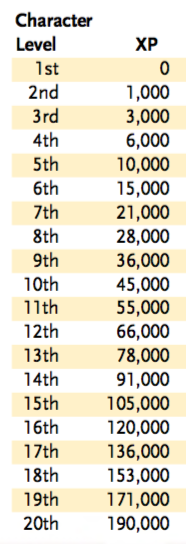
Player characters in the Old World campaign setting receive experience points for new experiences.
So, killing a monster (or otherwise overcoming it—driving off an enemy is generally as good as slaying it, as is negotiating with it to make it an ally, or otherwise “converting something which is a dangerous obstacle to achieve your goals, into something which is not that”) does indeed yield XP, and a good bit of it, too—but only the first time. Do the same thing again, and you get less XP for it. Killing your twentieth goblin, for example, gets you nothing.
Finding unusual or unique treasure likewise yields XP, as does exploration, the discovery of new places (if they’re different from what you’ve seen before), learning previously-unknown lore, figuring out new ways of doing something, etc. In short: have new experiences, and you will earn experience points.
Note: Characters in the Old World campaign setting, regardless of which rule set they are built with (D&D 3.5, the Beyond Ragnarok rules, Pathfinder, etc.), use the D&D 3e XP track to determine how much XP is needed to advance to the next character level (see table at right).
| Hit Points for Bigger Creatures |
|---|
| Size | HP Multiplier |
|---|
| Large | ×11⁄2 |
| Huge | ×2 |
| Gargantuan | ×3 |
| Colossal | ×4 |
Creature hit points
Creatures that are larger that Medium-sized multiply their hit points from Constitution bonus by a factor based on size; see Table: Hit Points for Bigger Creatures. (Note that this multiplier does not apply to hit points gained from hit dice, only to hit points gained from a creature’s Con bonus.)
Stealth & combat
The rules that describe how the Stealth skill interacts with making attacks are modified, in the following way.
The “sniping” rule no longer exists.
When a character who is currently hidden makes an attack, the target of the attack (as well as anyone else who is in a position to see the hidden character) may immediately make a new Perception check to notice and locate the hidden character (against a DC equal to the hidden character’s existing Stealth result). This Perception check gets a bonus depending on how obvious or noticeable the act of attacking is. (Generally, this is +20 for melee attacks, and anywhere from +0 to +10 for ranged attacks, depending on weapon: +10 if the hidden character is attacking with a bow, +5 for a crossbow, +0 for a blowgun.)
Regardless of whether such Perception checks (if any) are successful, a hidden character who had to move out of hiding in order to make an attack is automatically noticed and located at the end of his turn, if he has not successfully hidden again by then. A character who moves out of hiding, then moves back into hiding (i.e., into an area where he has cover or concealment) before the end of his turn, may make a new Stealth check (at his normal Stealth modifier, with no special penalty); if this check is successful, then the character’s stealth remains un-broken (assuming that he wasn’t noticed and located due to making an attack, or taking some other action that caused him to be noticed).
Using poisons
The Poisonmaking skill is available. The following rules supersede the “Note” on the linked skill page:
Poisonmaking is a class skill for rogues and for any class that grants the poison use class feature (assassin, blackguard, etc.). Any class that grants the poison use class feature also grants 1 free rank in Poisonmaking per class level.
A character has a 5% chance of exposing himself to a poison whenever he applies it to a weapon or otherwise readies it for use. A character who has ranks in the Poisonmaking skill reduces this chance by 1% per rank; a character who has ranks in the Alchemy skill likewise reduces this chance by 1% per 2 ranks. (Thus, for example, a character who has 4 ranks in Alchemy and 2 ranks in Poisonmaking would have only a 1% chance of exposing himself to a poison whenever he readies it for use.) The poison use class feature eliminates this chance entirely.
Additionally, a character who rolls a natural 1 on an attack roll with a poisoned weapon must make a DC 15 Reflex save or accidentally poison himself with the weapon.
A creature with a poison attack is immune to its own poison and the poison of others of its kind.
Bleed effects & healing
When a creature is suffering from a bleed effect that deals hit point damage, any healing received by that creature is applied to the bleed first, with any remaining healing restoring hit points as normal. (For example, a creature that is bleeding for 4 points per round, upon receiving 5 points of healing, stops bleeding and also regains 1 hit point.)
When a character uses the Heal skill to treat bleed damage, the DC for the Heal check is 10 + the severity of the bleeding (i.e., the amount of bleed damage being taken each round). (For variable-severity bleeding, e.g. from the Bleeding Critical feat, use the average damage to set the Heal check DC.)
Disabled & dying characters
A character with 0 hit points or fewer is considered disabled.
Whenever a disabled character takes damage, or whenever a character takes damage that causes him to become disabled, he must make a DC 10 Fortitude save. His current hit point total (after taking the damage) is applied as a penalty to this save. Failing this save means that the character falls unconscious; success means that the character is conscious (but disabled). The character also falls prone, unless he succeeds on the Fortitude save by 5 points or more.
A character who is disabled but conscious moves at half speed and may only take a single action per round (standard, move, or swift; a disabled character may not take immediate actions). A disabled character who performs a standard action (or any other strenuous action, such as casting a quickened spell) takes 1 point of damage after the action (and therefore must make another Fortitude save to remain conscious).
Additionally, a disabled character takes 1 point of damage per round (at the end of his turn) until he stabilizes (and therefore must make another Fortitude save to remain conscious).
Spell save DCs
Spell save DCs use the following formulas.
For full (9th-level; wizard, etc.) spellcasting progressions:
Spell save DC =
10 + floor (spell level ÷ 3) + floor (spellcasting class level ÷ 3) + other modifiers
(spellcasting ability score modifier, etc.)
For two-thirds (6th-level; bard, etc.) or “hybrid” (4th-level; ranger, etc.) spellcasting progressions:
Spell save DC =
10 + floor (spell level ÷ 2) + floor (spellcasting class level ÷ 3) + other modifiers
(spellcasting ability score modifier, etc.)
Note on “spellcasting class level”: The level used in the save DC formulas above is not the caster level of a spell, nor is it the number of class levels in any given class (or combination of classes). Rather, it is the effective class level that is used for the purpose of determining how many spells per day a character has in the relevant spellcasting progression (e.g. wizard, cleric, etc.). (For single-classed characters, or any characters who do not have any levels in prestige classes that grant spellcasting level advancement, this level will simply be equal to their class level in the relevant spellcasting class.)
Examples: The spellcasting class level of a single-classed, 14th-level wizard (for the purposes of determining the save DCs for his wizard spells) is 14. The spellcasting class level of a fighter 4 / wizard 5 / eldritch knight 5 (for the purposes of determining the save DCs for his wizard spells) is 9 (from 5 levels of wizard + 4 levels of wizard spellcasting progression gained from 5 levels of eldritch knight).
Group actions
Sometimes, a group of characters attempt to accomplish a task, where each must succeed, but all can assist each other. (Examples: sneaking past some guards, while the stealthy characters help their less-stealthy friends avoid making noise; climbing up a cliff side, while the more athletic party members give boosts to less-athletic ones.)
In such a case, any character who wishes to aid his companions may accept a −5 penalty to his check. (Characters must decide who will provide or accept assistance before any checks are rolled. No character may both provide and accept aid for any given task.)
Any character who receives assistance gains a +2 bonus on their check. Bonuses from multiple assisting characters stack. (Depending on the nature of a task or situation, DM may set limits on how many companions one character may assist, or how many characters may aid a single companion; however, for most tasks, the size of a typical adventuring party ought to lie well within such limits.) Note that such assistance cannot cause any character’s check result to exceed the highest unassisted check result of any character assisting them.
Incorporeal creatures & positive/negative energy
Positive and negative energy are fully effective against incorporeal creatures (rather than 50% effective, as most other magical attacks are). (Any saving throws still apply, etc.)
Rules
The following are all the pages related to game rules/mechanics in the Old World campaign setting.
New & Modified Classes
- Bard The bard uses skill and spell alike to bolster his allies, confound his enemies, and build upon his fame.
- Monk An ascetic who seeks perfection in thought and deed, honing body and mind into weapons on the battlefield.
- Summoner Spontaneous arcane spellcaster who shares a close bond with a mysterious creature called an eidolon.
- Witch Arcane spellcaster who gains power through a pact with a mysterious, otherworldly patron.
Class Abilities
- Ki powers Rules for ki powers, and the powers available to monk player characters in the Old World campaign setting.
- Rage powers Rules for rage powers, and all the powers available to barbarian player characters in the Old World campaign setting.
- Rogue talents Rules for rogue talents, and all the talents available to rogue player characters in the Old World campaign setting.
Magic
- Rituals Methods of creating magical effects without the use of spell slots.
- Spell lists All the spells available to player characters in the Old World campaign setting.
- Tampering with mortality Resurrection magic—its use and its consequences.
Skills
- Handle Animal Rules for domesticating and training animals.
- Skill tricks Rules for skill tricks, and all the skill tricks available to player characters in the Old World campaign setting.
Other Rules
- Conditions Various conditions which may affect characters.
- Corruption The taint of evil, and its consequences.
- Feats All the feats available to player characters in the Old World campaign setting.
- Psionics Rules for psionic characters, psionic powers, psionic feats, etc.
- Races List of available player character races in the Old World, and racial traits for each.
- Reputation Rules for determining how well known the PCs are, and what they’re known for, and what comes of this.
- Ventures & hirelings Rules for hiring people and running business endeavors.
Locations
The Old World Gazetteer describes all locations on one page.
- Altered cleft oasis An oasis within a small mesa canyon.
- Basilisk family lair Now-empty former lair of a family of basilisks.
- Caledas Large town, ~150 miles east-southeast of Drylake.
- Cool grotto A subterranean grotto with plants and a stream.
- Drylake Small town; one of the last outposts of civilization on the western edge of Donaille.
- Dusthill Frontier town at the edge of the western wastes.
- Evil cave-shrine Subterranean shrine to Demogorgon.
- Giscard’s home Isolated house in the hills, home to Giscard of Balidor.
- Goblin warrens Cramped, stinking cave-warrens teeming with goblins.
- Korrulan’s home Secluded retreat, home to Korrulan and his disciples.
- Lower caverns Caverns that lead to the Master’s domain.
- Metalstorm Hills A region of latent magic which creates localized storms of metal shards, and pulls metallic objects into it.
- Old cemetary Old cemetary, for a settlement that itself is long gone.
- Old guard tower An old guard tower on a hill.
- Outcast cave-village Cave-dwelling of a small band of exiles from the Master’s tribe.
- St. Aurantius Castle Abandoned castle, ~25 miles southeast of Dusthill. Currently infested by undead creatures.
- Strange crystal cave Damp cavern with glowing mushrooms and odd crystals.
- Sunset Heights Ruins of ancient buildings, of extraordinary size and strange construction.
- The Master’s domain Subterranean domain, inhabited by humans, ruled by the Master.
- Uthlar’s tower Uthlar’s tower.
Organizations
Characters
Player characters
Adventuring parties